
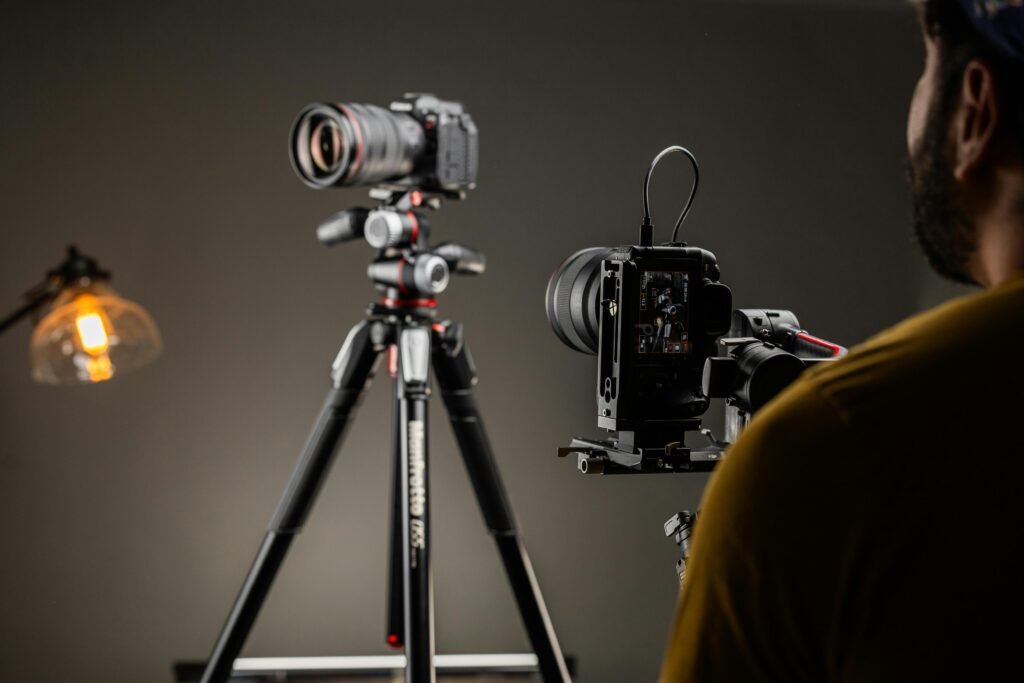
If you’ve been holding onto your DSLR, waiting for the “right time” to go mirrorless, that time has officially arrived. In 2025, mirrorless cameras now account for over 85% of new interchangeable-lens camera sales, and the major manufacturers have made it clear: the future is mirrorless, and the future is now.
But this isn’t just about following trends. The mirrorless shift represents a fundamental change in how creators work—especially if you’re shooting both photos and video. Here’s what you need to know before making the jump.
Why Mirrorless Cameras Have Won
The numbers tell a compelling story. Canon and Nikon both announced they would no longer develop new DSLRs, focusing entirely on their mirrorless systems. Sony, which led the early full-frame mirrorless push, continues to dominate alongside Canon in what has become a two-horse race for market leadership.
But beyond the corporate strategy, there are real, practical reasons why creators are making the switch:
1. True Hybrid Capability
Unlike DSLRs that need to “switch modes” to record video, mirrorless cameras are video-ready by design. Many brands now market certain mirrorless models as true hybrid cameras, equally adept at pro photography and cinematography. You’re not compromising on either side—you’re getting a tool that excels at both.
2. Smaller, Lighter, Quieter
Without the mirror mechanism, mirrorless bodies are mechanically simpler and generally more compact than equivalent DSLRs. For wedding photographers shooting 10-hour days or travel creators constantly on the move, this weight reduction isn’t a luxury—it’s a necessity.
3. What You See Is What You Get
Electronic viewfinders now preview exactly how your shot will look with current settings in real-time. No more chimping after every shot to check exposure. Modern EVFs boast extremely high resolution (5 to 9 million dots) and fast refresh rates, with flagship models approaching optical finder clarity.
4. AI-Powered Autofocus
Modern mirrorless cameras leverage AI-based subject detection for eye/face/animal tracking that simply wasn’t possible with DSLR phase-detection systems. Nearly 73% of professional photographers were shooting with mirrorless systems by 2022, and that number has only grown.
The Real-World Trade-Offs
Let’s be honest about what you’re giving up:
Battery Life: Electronic viewfinders and screens drain power faster than optical finders. You’ll need to carry spare batteries—plan on it.
The Optical Experience: Some photographers still prefer the zero-lag, direct view of a DSLR’s optical viewfinder, especially for fast action in challenging light.
Lens Investment: If you’re switching systems entirely, you’re looking at new glass. While adapters exist, native lenses take full advantage of the shorter flange distance and electronic communication.
But here’s the thing: recent models and expanded lens lineups have largely closed the early gaps that plagued first-generation mirrorless cameras.
Which Mirrorless Camera Actually Fits Your Work?
The market has matured to the point where there’s a mirrorless option for virtually every creator type and budget:
For Budget-Conscious Beginners: The Canon EOS R50 offers 4K 60p with 10-bit recording in a compact body under $1,000. It’s a legitimate entry point that doesn’t feel like a compromise.
For Content Creators: The Sony ZV-E10 Mark II is purpose-built for vlogging with 10-bit 4K 60fps, uncropped recording, and gyro-based stabilization. It’s what happens when a camera company actually listens to YouTubers.
For Hybrid Shooters: The Nikon Z6 III brings 6K 60p RAW video and 20fps burst shooting with a “partially stacked” sensor that delivers flagship performance at a mid-tier price.
For Wedding & Event Pros: The Canon EOS R6 Mark II combines in-body stabilization, dual card slots, and exceptional low-light performance in a weather-sealed body that can handle the demands of all-day shoots.
For Serious Filmmakers: The Sony FX30 offers 4K 120p, S-Cinetone color science, and a built-in fan for unlimited recording—professional cinema features in an APS-C body.
Full-Frame vs. APS-C: The Debate Continues
Here’s where it gets interesting: while full-frame sensors have become more affordable and dominant in the mirrorless space, APS-C models are projected to retain roughly 47% of the mirrorless market.
Why? Because APS-C delivers serious performance in a smaller, more affordable package. Recent models like the Fujifilm X-H2S prove that crop-sensor cameras can shoot 40MP stills and 6K video without compromise.
The choice isn’t about “better”—it’s about what fits your workflow and budget.
What’s Coming Next
The mirrorless revolution isn’t slowing down. Manufacturers are pushing boundaries with:
- Global shutter sensors that eliminate rolling shutter distortion entirely
- 8K internal recording becoming standard in flagship bodies
- AI-powered features for automatic scene recognition and subject tracking
- Computational photography bringing smartphone-style processing to dedicated cameras
Nikon’s $223 million acquisition of RED Digital Cinema signals where the industry is headed: professional video features are no longer optional extras—they’re core expectations.
Making the Switch: What You Actually Need
If you’re ready to go mirrorless, here’s the honest gear list:
- The Body: Choose based on your primary use case (stills vs. video vs. hybrid)
- One Versatile Zoom: A 24-70mm f/2.8 or similar covers 80% of real-world shooting
- Extra Batteries: At least two spares—this isn’t negotiable
- Fast Memory Cards: V60 or V90 rated for 4K/6K recording
- A Prime Lens: A 35mm or 50mm f/1.8 for low-light and creative work
You don’t need to replicate your entire DSLR kit on day one. Start with the essentials and build as your needs evolve.
The Bottom Line
The mirrorless revolution isn’t about abandoning what works—it’s about embracing tools that work better for how we create today. Whether you’re shooting weddings, building a YouTube channel, or documenting your travels, there’s a mirrorless camera that fits your workflow without forcing you to compromise.
The question isn’t whether to make the switch anymore. It’s which system will help you create your best work.